In Development
Applying Rigor to Marketing Projections
Projections built without explicit documented assumptions have nothing to monitor, nothing to update, and no early signal when reality diverges from expectation. A framework for building marketing forecasts the way less mushy disciplines already do.
Envisioning an AI-Powered Marketing Organization
How do you conceptualize the ways AI can actually help a marketing team, across knowledge management, insight generation, and planning support? From there, what are the practical challenges to implementation, and what approaches address them? A practitioner framework.
"We Compete on Trust and Service"
In banking, insurance, healthcare, and legal, genuine product differentiation is hard to achieve and often legally constrained. The standard response is to declare a positioning advantage instead. Many organizations treat naming the desired position as equivalent to actually occupying it. A look at what real differentiation requires in industries where the obvious answers are mostly hollow.
What Metrics Actually Measure
A framework for identifying what your metrics actually capture, why North Star KPIs should be ratios with a clear value direction rather than descriptive counts, and other patterns and failure modes worth naming before they cost you.
Beyond GEO and SEO: The Case for a Unified Digital Brand Presence Model
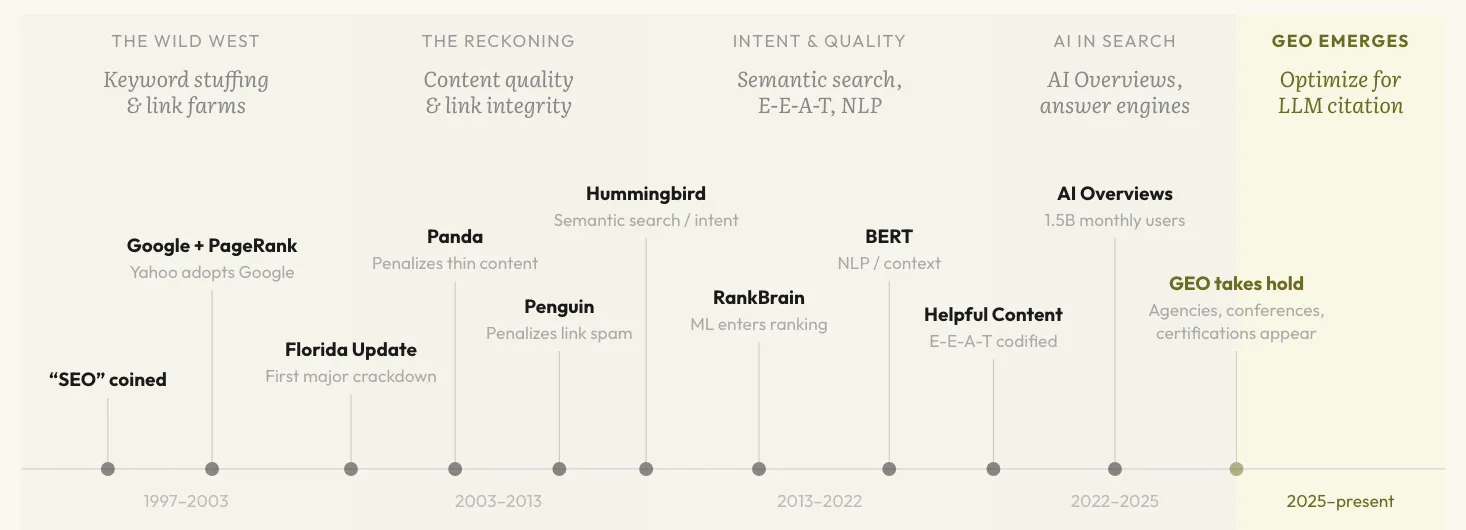
SEO and GEO are treated as separate disciplines, but they share a common foundation. It's time for a unified model of digital brand presence.
Building an AI-Empowered Marketing Organization
A practical framework for integrating AI into marketing organizations without losing the human judgment that makes marketing work.
Building a Marketing Organization: Models and Structures of Agency Utilization
A framework for how in-house marketing departments should think about structuring their agency relationships — from fully outsourced to fully insourced and everything in between.
Triangulating Truth: A Model for Marketing Measurement
Click attribution is just one signal, and not a reliable one on its own. A practical model for combining attribution, incrementality testing, and qualitative inputs to get closer to the truth about what's actually working.
Bill Gates Lied to Us
The early internet promised more efficient markets. It delivered extraction engines instead. This isn't a story about villains. It's about a system where locally rational decisions produce worse outcomes at the societal level.
A Distinction Without a Difference
Building segments to understand your market is still fundamental. But translating those segments into in-platform targeting, third-party data purchases, and manual audience selection is increasingly counter-productive in an era of auto-optimizing AI.
Seeing Like a CMO
The same forces that doomed Soviet collective farms and planned cities play out every time a new marketing leader blows up existing structures before understanding why they exist. What James C. Scott's political science classic teaches us about driving transformation without destroying institutional knowledge.